
A self-hosted AI platform is a private infrastructure that runs AI models entirely within a company's own servers or private cloud. It keeps all your data internal, never processed by third-party systems. Businesses that handle sensitive client data, financial records, or internal knowledge bases use self-hosted AI to retain full compliance and security control. Quintagroup has deployed LibreChat-based private AI environments for clients in FinTech, eProcurement, and professional services since 2003 and has deployed LibreChat-based private AI environments since 2024. Quintagroup uses an approach called the Private AI Deployment Framework (PADF), which is a structured seven-phase methodology.
Most teams already use AI. However, the work is scattered across multiple tools. One for writing, another for coding, a third for data analysis. Each carries separate subscriptions, separate interfaces, and separate data exposure risks. A self-hosted, unified AI workspace eliminates this fragmentation.
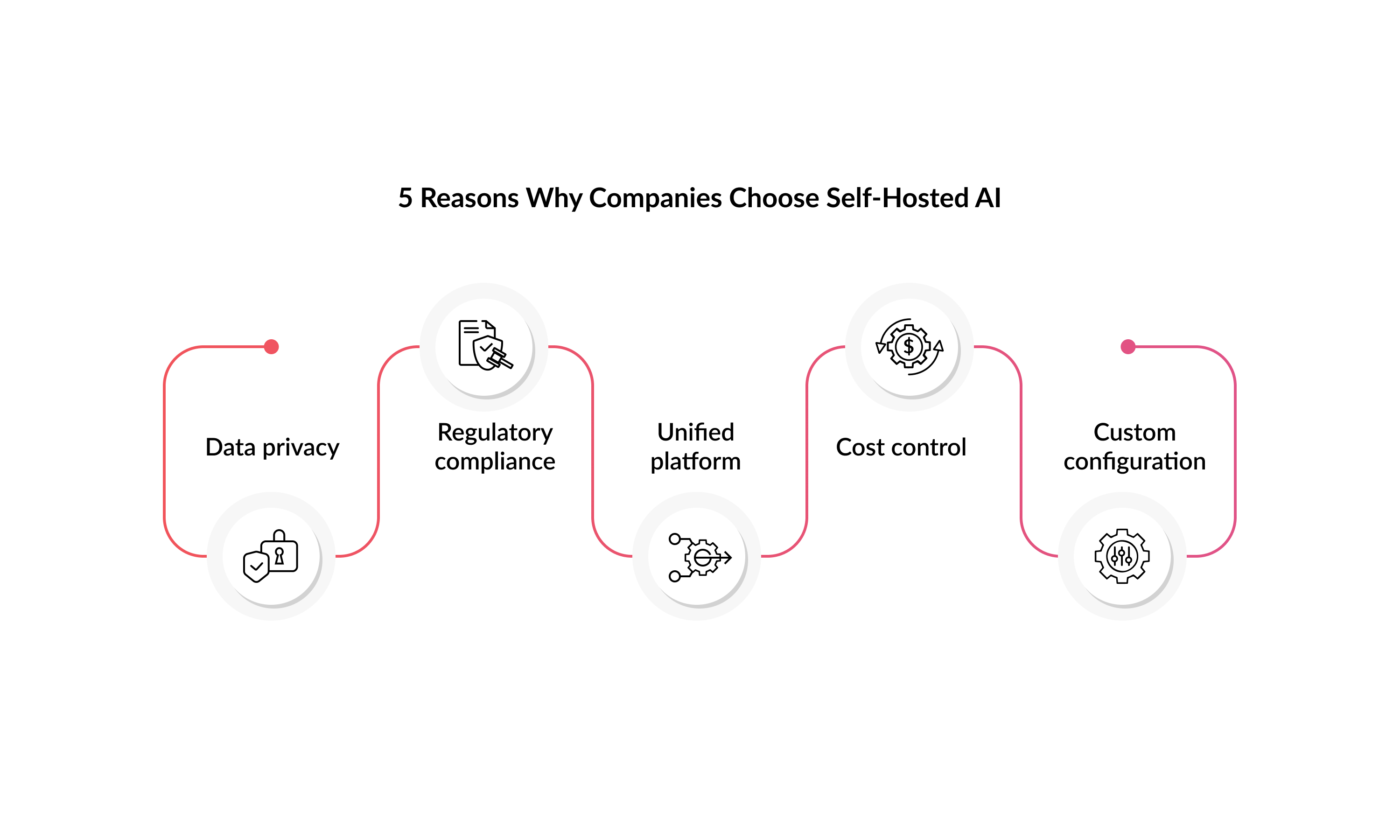
5 Reasons Why Companies Choose Self-Hosted AI
- Data privacy: All interactions remain inside the company’s own infrastructure, and no external API logs or vendor data retention are involved.
- Regulatory compliance: Meets GDPR, HIPAA, SOC 2, and sector-specific data residency requirements.
- Unified platform: Replaces multiple separate AI subscriptions with one controlled environment.
- Cost control: Eliminates unnecessary SaaS subscriptions, which makes your infrastructure costs predictable.
- Custom configuration: Everything is configured to match your specific business processes
Quintagroup has implemented LibreChat-based private AI platforms for clients in FinTech, eProcurement, and professional services — including teams previously relying on 4+ separate AI tools simultaneously.
What Is LibreChat and How Does It Power Private Enterprise AI?
LibreChat is an open-source AI assistant platform that runs entirely on a company's own infrastructure and connects to multiple model providers (OpenAI, Anthropic Claude, Google Gemini, and others) through a single interface. If you handle sensitive client data, financial and operational information, internal documentation, and knowledge bases, this tool will become a game-changer. Leaving the external systems behind, you gain a private AI platform where every interaction remains under your control. Users log into the system using corporate accounts and work in a secure, centralized environment.
The platform connects to multiple AI model providers simultaneously:
- OpenAI for general-purpose tasks such as writing, summarization, and code generation
- Anthropic Claude for advanced reasoning, long-context analysis, and structured problem-solving
- Google Gemini for multimodal capabilities, including text, image, and data-driven workflows
- Groq for high-performance inference and fast-response workloads
- Perplexity for research-oriented tasks with real-time, citation-based answers
This flexibility allows you to select the most suitable model for each task without disrupting the workflow. For example, you can:
- Select one model for code generation and debugging
- Use another for content creation
- Apply a third model for data processing and analysis
When you combine all of these capabilities into a single environment with LibreChat, you’ve got a future-ready AI ecosystem on your hands. And believe it or not, you will not recognize your work processes after this implementation.
What Features Does a LibreChat-Based Platform Include?
LibreChat is made to be used right away. You can begin working without further onboarding because of its familiar UI.
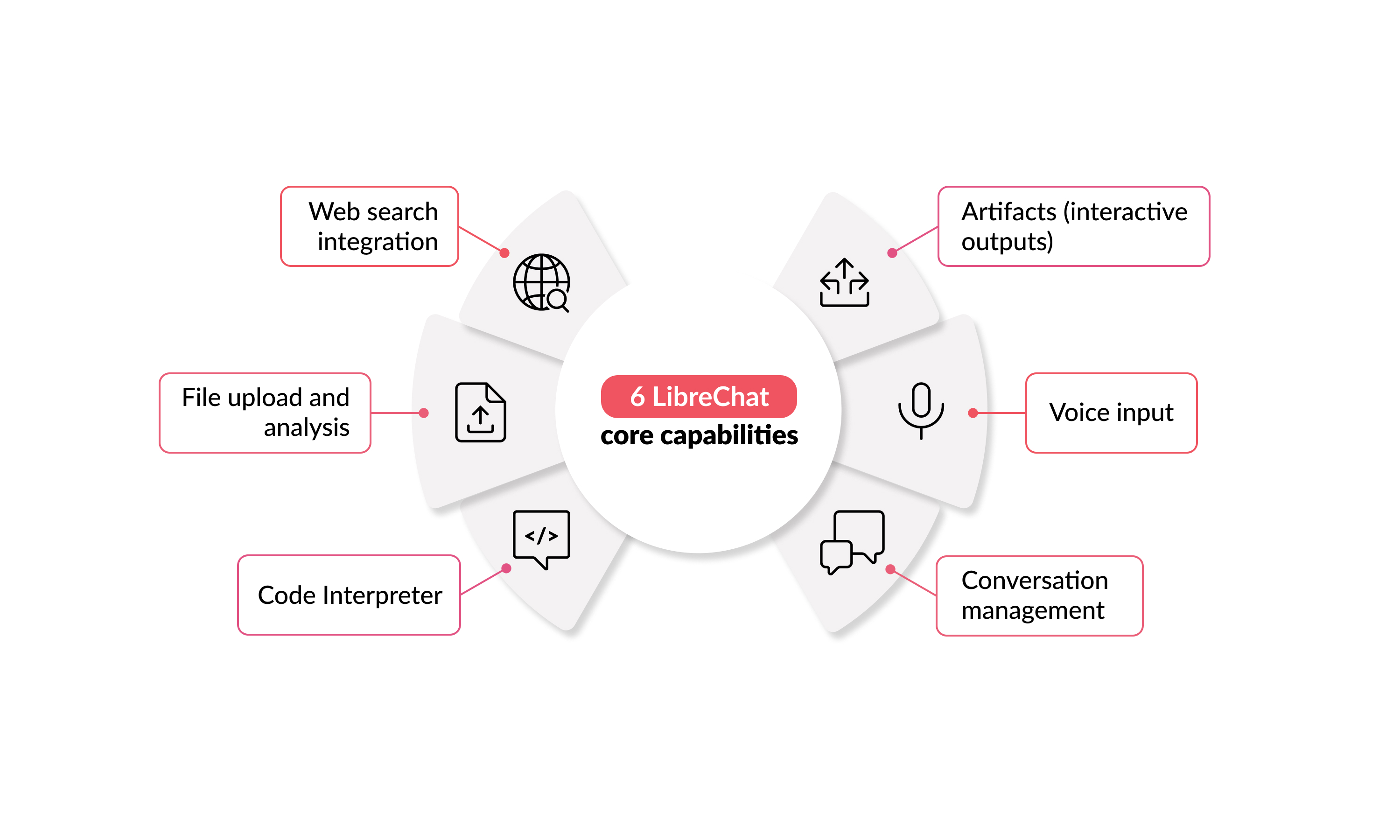
6 LibreChat core capabilities you’ll gain:
- Web search integration: AI accesses live web data during conversations
- File upload and analysis: You upload PDFs, spreadsheets, and documents, and AI extracts summaries, answers, and insights
- Code Interpreter: Executes Python and other code directly in chat
- Artifacts (interactive outputs): Generates live, functional tools rendered inline in the chat window
- Voice input: Hands-free interaction via speech-to-text
- Conversation management: Save, organize, tag, export, and share chat sessions across teams
These features make the platform a unified and complete environment for AI workflow automation, where tasks are executed.
How Do AI Agents and Prompt Templates Work Inside LibreChat?
LibreChat enables two layers of automation that transform one-off interactions into repeatable business processes: prompt templates and AI Agents.
Prompt Templates
Frequently used instructions are kept as reusable templates with dynamic variable fields. Teams can standardize the output quality for regular tasks. Templates are shared across departments to ensure consistency and format.
AI Agents
Agents are dedicated AI modules pre-configured with a fixed context, tools, and instructions. Common enterprise agent configurations include: document processing agent, report generation agent, and support.
Both templates and agents are shareable within the team workspace, making AI knowledge reusable.
Interactive Outputs with Artifacts
Artifacts can introduce a new way of working with AI. They turn responses into functional tools. Instead of receiving static text, you can generate live, interactive interfaces within seconds.
When you create an artifact, the interface splits into two parts:
- A conversational panel for ongoing interaction
- A live preview panel displaying the generated tool
You can build:
- Financial calculators (tax, pricing, ROI)
- Internal forms and data input tools
- Interactive dashboards and visualizations
This erases the gap between idea and execution. You get everything, all in one. Testing ideas immediately, refining them in real time, and sharing results without involving additional development resources - this is the workflow you deserve.
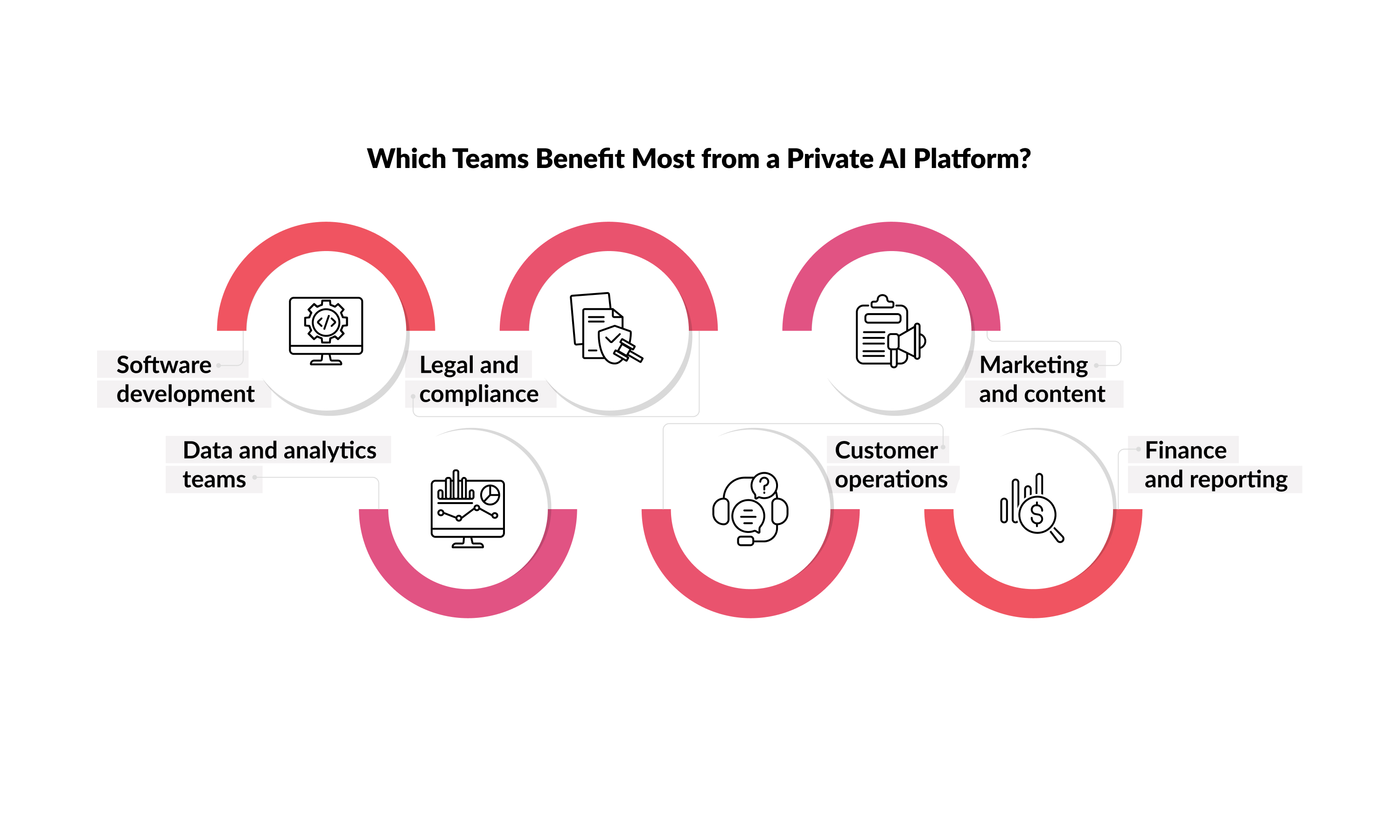
Which Teams Benefit Most from a Private AI Platform?
A self-hosted AI platform like LibreChat integrates naturally into daily workflows in your team. Its flexibility and tailored approach allow each team to use it in a way that fits their specific needs:
- Software development: Write, review, and document code within a single interface, conduct live debugging sessions.
- Data and analytics teams: Upload datasets and receive statistical summaries, visualizations, and forecasts.
- Legal and compliance: Process contracts without sending documents to external AI services.
- Customer operations: Reduce average handle time by generating first-draft email responses using pre-configured agent templates.
- Marketing and content: Draft, iterate, and localize content across GPT-4o and Claude models.
- Finance and reporting: Build interactive financial calculators and dashboards using Artifacts.
How Does Quintagroup Implement a Self-Hosted AI Platform?
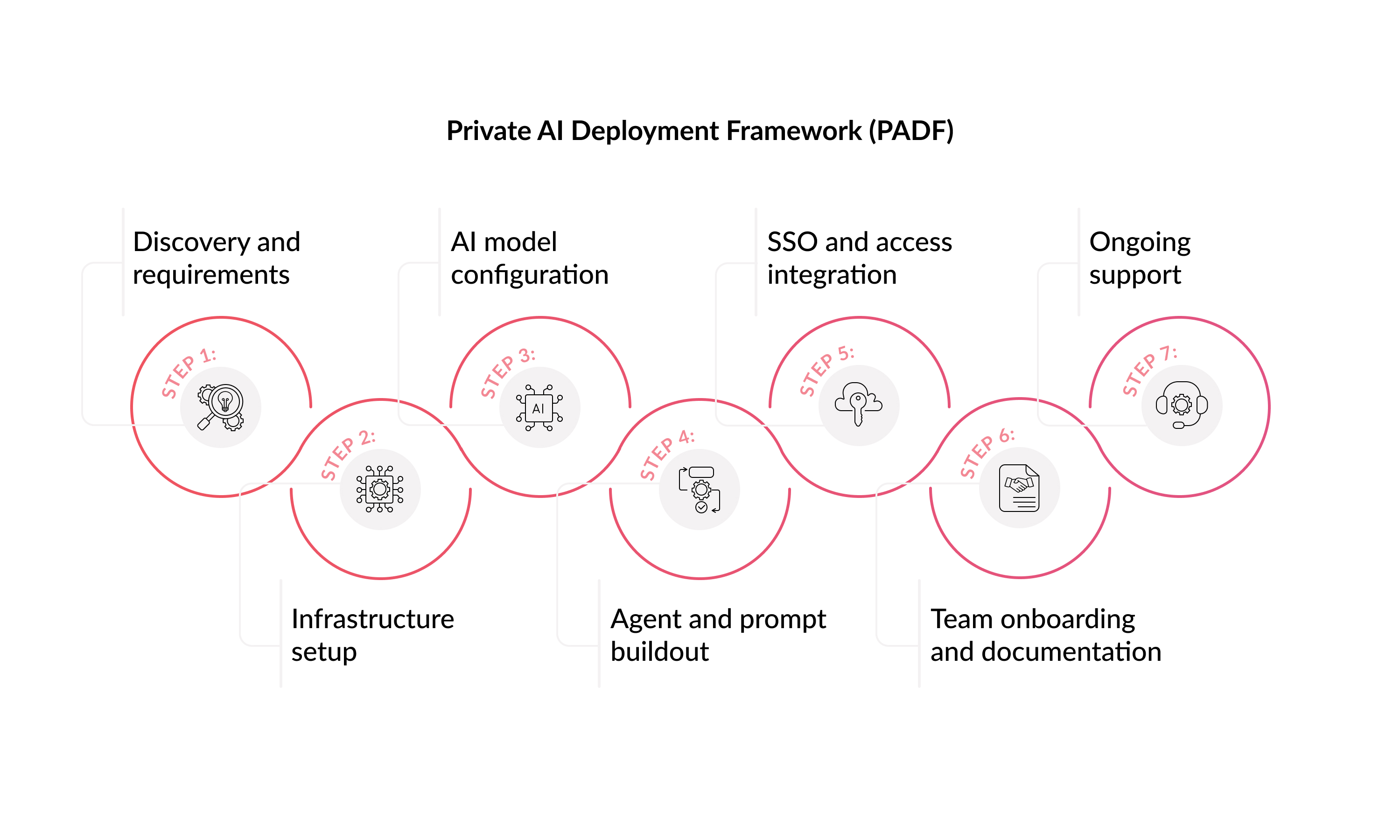
Quintagroup has been building custom digital infrastructure since 2003, with implementations across government procurement systems, FinTech platforms, and enterprise SaaS products. Quintagroup uses the Private AI Deployment Framework (PADF), which consists of 7 steps:
Step 1: Discovery and requirements
Audit of current AI tool usage, identification of data sensitivity requirements, and definition of team workflows to automate.
Step 2: Infrastructure setup
Server configuration or private cloud provisioning on AWS, GCP, or Azure.
Step 3: AI model configuration
Connection and testing of selected AI providers.
Step 4: Agent and prompt buildout
Creation of team-specific agents and prompt templates based on identified workflows
Step 5: SSO and access integration
Connection to the corporate identity provider for seamless user access
Step 6: Team onboarding and documentation
Live onboarding sessions for end users.
Step 7: Ongoing support
Maintenance, model updates, security patches, and feature additions as requirements evolve
Self-Hosted AI for FinTech Platforms
For a FinTech client managing sensitive loan origination data, Quintagroup deployed a LibreChat instance on a private AWS VPC with no external API routing. The team replaced four separate AI subscriptions with a single internal workspace, reduced onboarding time for new AI users from 2 weeks to 3 days, and achieved compliance with SOC 2 Type II data handling requirements.
Get a Private AI Platform Your Team Controls Fully
AI can become a core component of your modern business operations. Its success depends on how well it is integrated into workflows and how securely it is managed. Quintagroup can promise the quality of it. Get one interface for all AI interactions, secure, internal data processing, and infrastructure for future growth.
Contact Quintagroup to schedule a scoped assessment: describe your current requirements, and the team will design a deployment plan with a timeline and cost estimate within 5 business days.
Frequently Asked Questions
What is a self-hosted AI platform, and how is it different from ChatGPT or Claude?
A self-hosted AI platform runs entirely within your own infrastructure. A self-hosted solution like LibreChat connects to the same underlying AI models but routes all interactions through your private network, keeping data under your full control.
How long does it take to deploy a LibreChat-based AI platform for a team?
A standard LibreChat deployment by Quintagroup takes 3 to 6 weeks from kickoff to production launch. A basic setup can be live in 2 weeks. More complex deployments involving custom agents, multi-department workflows, and on-premise server configuration typically run 4 to 6 weeks.
Which AI models can be accessed through a self-hosted LibreChat platform?
LibreChat supports simultaneous access to OpenAI, Anthropic Claude, Google Gemini, Groq, and Perplexity. It also supports locally hosted open-source models. Model access is configured per user role, so different teams can use different model sets based on cost and capability requirements.
Is a self-hosted AI platform suitable for companies without a large IT team?
Yes. Quintagroup handles the full infrastructure setup, configuration, and ongoing maintenance. Post-deployment, day-to-day management (adding users, adjusting prompt templates, updating model versions) requires standard IT administration skills. Quintagroup provides written runbooks, admin training, and monthly maintenance.
How does a self-hosted AI platform handle data security and compliance?
In a self-hosted deployment, all AI interactions are stored exclusively on your own servers or private cloud. No data is sent to outside vendors. This architecture supports GDPR Article 25 (data protection by design), HIPAA technical safeguards, and SOC 2 Type II access control requirements.
How much does it cost to implement a private AI platform for a business?
The implementation cost depends on deployment complexity, infrastructure scale, and the number of custom agents and integrations required. A deployment for a team of 20 to 50 users with standard model connections typically takes 3 to 4 weeks. Enterprise-scale deployments run 5 to 8 weeks. Contact Quintagroup with your team size, data sensitivity requirements, and current AI tool spend, and we’ll scope the estimate with fixed pricing.