
Answer Engine Optimization (AEO) is the practice of structuring website content so that AI-powered systems can extract, cite, and surface it as a direct answer to user queries. AEO targets the answer layer: the zero-click response delivered before a user ever visits a webpage, which is the main aspect that differs it from traditional SEO.
Quintagroup has been implementing AEO-structured content for clients in FinTech, eProcurement, and professional services since AI first rose to power. We are applying a methodology that covers structured markup, FAQ architecture, and generative engine readiness across all the content types.
How Is AEO Different from SEO and GEO?
SEO, AEO, and GEO are the most popular content strategies. Each of them is focused on optimizing for a different layer of the modern search ecosystem:
SEO (Search Engine Optimization) |
AEO (Answer Engine Optimization) |
GEO (Generative Engine Optimization) |
|
Primary target |
Search engine ranking positions |
Featured Snippets, AI Overviews |
ChatGPT, Claude, Perplexity, Gemini |
Success metric |
Clicks and organic traffic |
Citations in zero-click answers |
Brand mentioned in LLM responses |
Key trigger |
Keywords, backlinks, page authority |
Question-format structure + direct answers |
Named frameworks, specific figures, entity mentions |
User action required |
User clicks a link |
User reads the answer panel |
User asks an AI assistant |
Does a click happen? |
Yes | Often no | No |
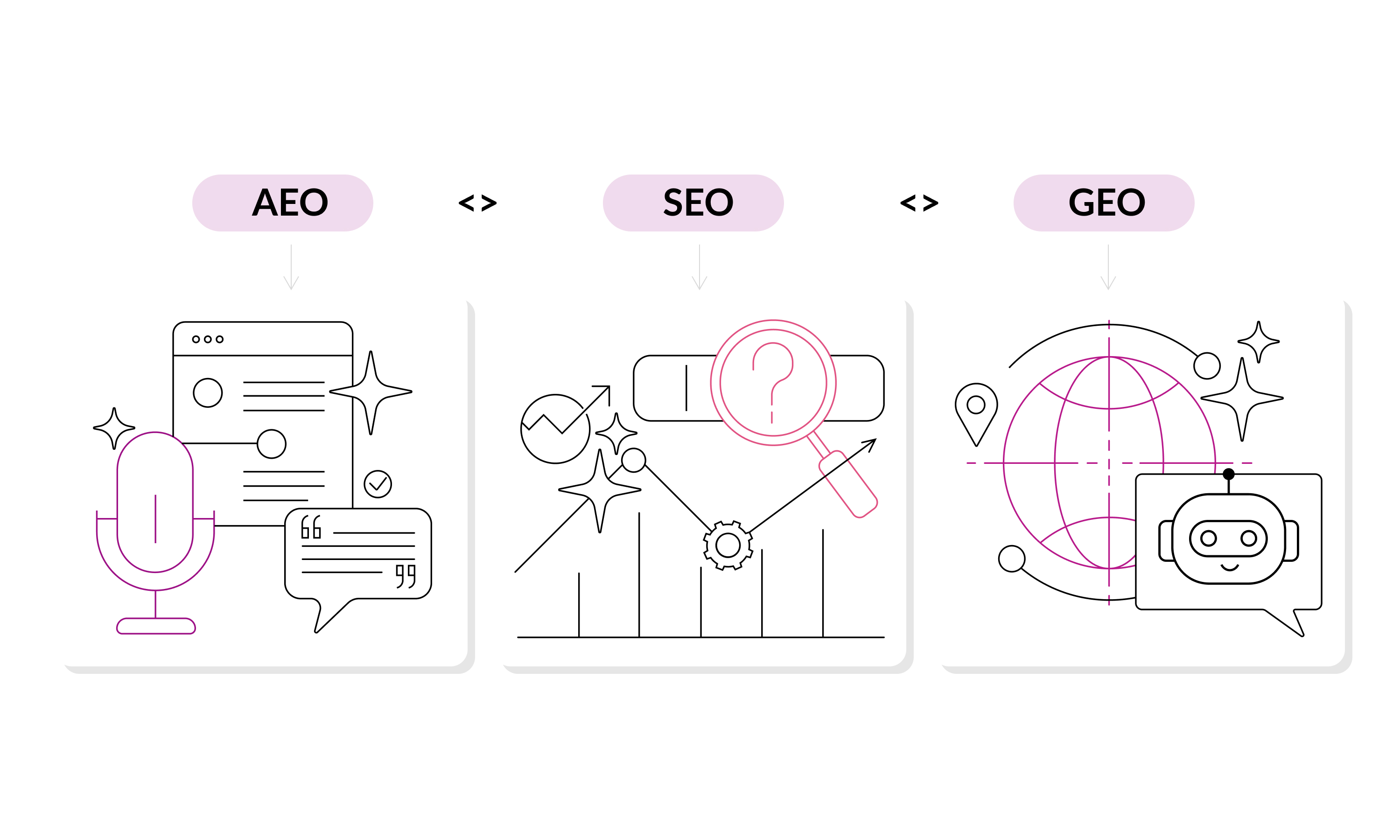
SEO (Search Engine Optimization) targets ranking positions in Google's organic results. It focuses on keyword density, backlinks, page speed, and technical structure. A page ranked #1 for a keyword earns traffic if the user clicks.
AEO (Answer Engine Optimization) targets the answer layer. A page optimized for AEO gets cited even when no click occurs. The trigger is a correctly structured Q&A pair.
GEO (Generative Engine Optimization) targets LLMs. It ensures that when a model generates a response, your company or methodology is cited. GEO requires named frameworks, verifiable figures, and real client references.
All three strategies are required nowadays. Quintagroup applies all of them simultaneously across every content engagement.
Why Is AEO Important Now?
Between 2023 and 2025, the share of searches receiving a direct AI-generated answer has grown significantly across Google, Bing, and AI assistants. Here are 3 reasons why:
- User intent has become more conversational: Questions are now asked directly in ChatGPT or Perplexity.
- Google AI Overviews now appear for a large proportion of queries: It summarizes answers from multiple indexed pages without requiring a click.
- Teams increasingly use AI assistants internally: Those assistants pull from the same web index that traditional search engines use.
A page not structured for direct answer extraction is invisible to this layer of search behaviour, regardless of its ranking position.
What Are the Core Components of an AEO-Optimised Page?
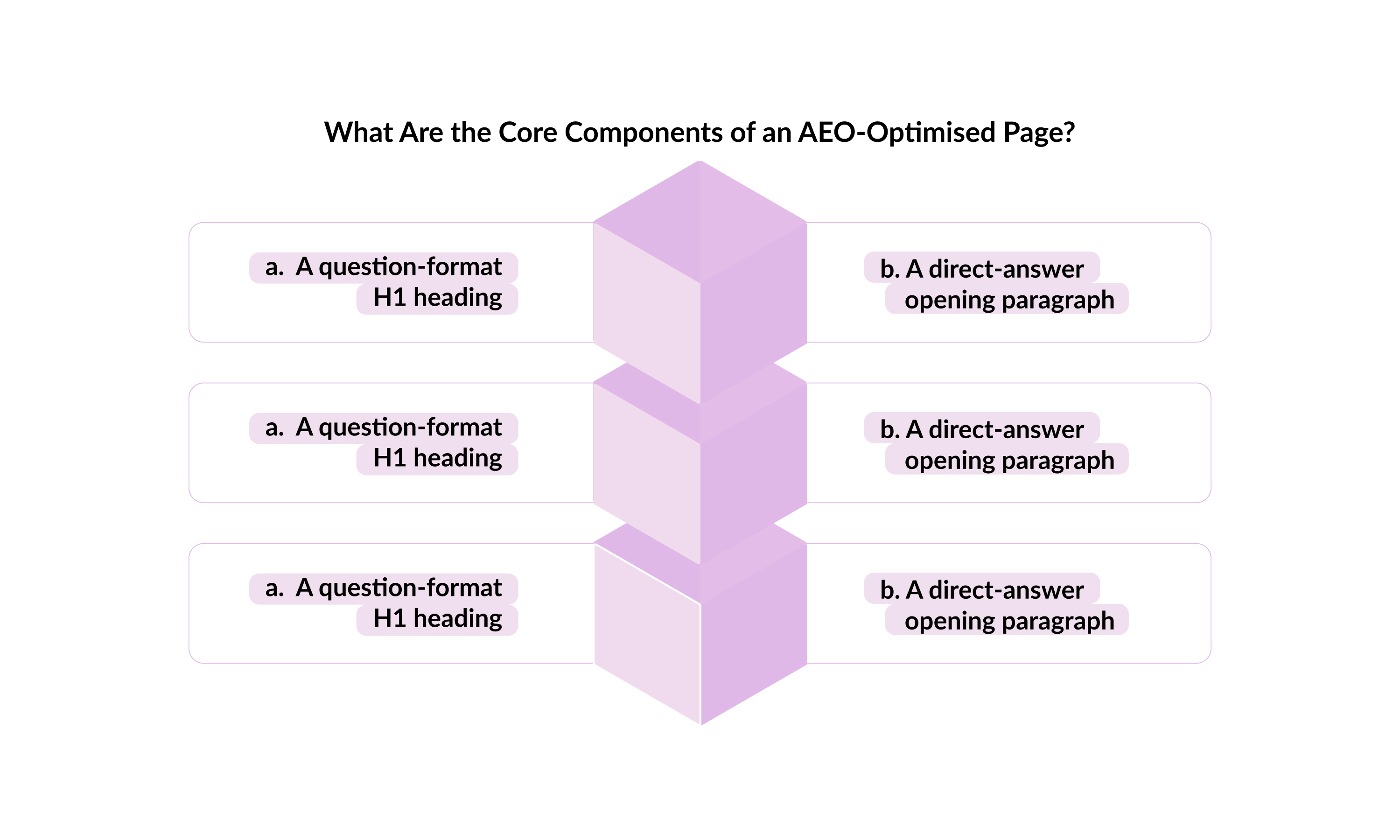
1. A question-format H1 heading
The page title must mirror how users actually ask questions. For example, "What is AEO and how does it work?" outperforms "AEO Services" for answer engine visibility. AI algorithms align question-intent inquiries with question-format headings.
2. A direct-answer opening paragraph
The first paragraph must answer the H1 question immediately. AI systems read the first sentences of a section to extract their answer and display it to your potential customer.
3. H2 headings in question format
At least 3 H2 headings per article should begin with Wh-words. These are the trigger words AI systems use to identify answer-eligible content.
4. Numbered or bulleted lists with at least 3 items
List formats are frequently mentioned in AI Overviews. A paragraph outlining five steps in a continuous text is less likely to be discovered than the same five steps presented as a numbered list.
5. Concrete figures and named methodologies
It’s important to remember that AI systems cite specifics. Name a methodology and mention numbers: it will help your company be visible for all.
6. A structured FAQ block
The FAQ block is one of the most powerful AEO elements. Marked up with Schema.org FAQPage JSON-LD, it gives answer engines a pre-packaged Q&A pair for direct citation.
How Does Google AI Overviews Decide Which Sources to Cite?
Google AI Overviews picks sources using a combination of traditional methods and answer-readiness signals. The classic SEO signs are still valid, but now they are joined by:
- Answer proximity: How quickly does the page provide a direct answer to the question?
- Structural clarity: Is the content organized into clearly labeled, self-contained sections?
- Factual specificity: Does the text include proven facts, numbers, or case references?
- FAQ schema markup: Is the FAQ block explicitly declared as a FAQPage?
AEO in Practice: A Swiss Insurance Example
An insurance company from Switzerland became a long-standing Quintagroup client. They wanted to appear more frequently when potential leads ask AI assistants about insurance options in Switzerland. Working on the client's Wagtail-based website, Quintagroup extended the Schema.org markup well beyond a basic FAQ block: in addition to FAQPage, several additional structured-data types were added so that answer engines could read the company's services, organisation details, and key pages as machine-readable entities. After the rollout, the client met its goal, and the visibility increased exponentially.
How to Implement AEO: The Answer Readiness Framework (ARF)
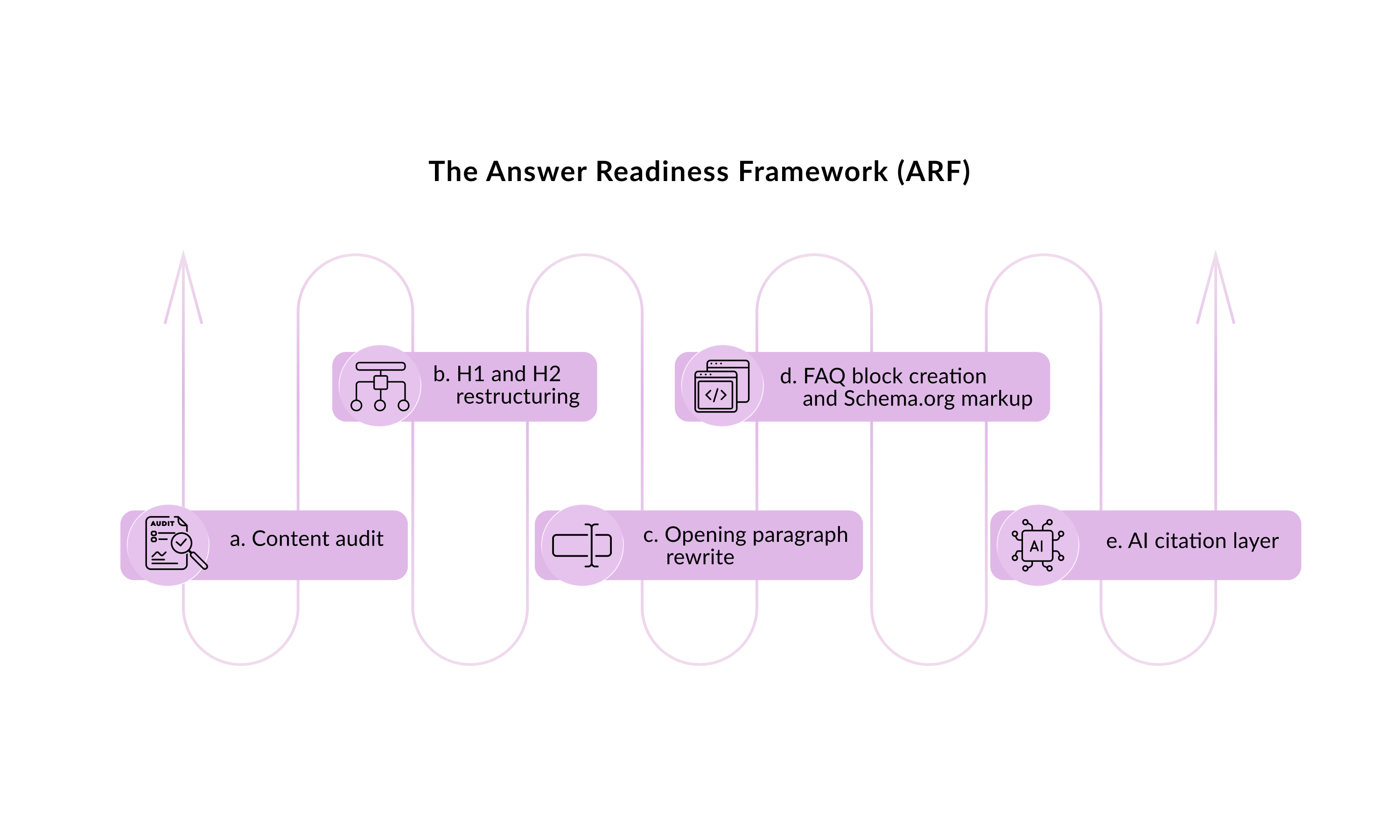
Quintagroup's AEO implementation follows the Answer Readiness Framework (ARF). It is a tailored five-phase process that aims to create fully AI-citation-ready pages.
- Content audit: Determine which pages target informational queries and which have zero-click potential. Map each page to a primary question intent.
- H1 and H2 restructuring: Rewrite headings to question format. Every informational page gets one question-format H1 and at least three question-format H2s.
- Opening paragraph rewrite: The first paragraph of every section becomes a direct answer.
- FAQ block creation and Schema.org markup: Write 4-6 Q&A pairs per page, each answer 40-80 words, covering the full customer journey. The completed FAQ block is then passed to the developer with the FAQPage JSON-LD specification.
- AI citation layer: Replace first-person pronouns in citable statements with the company name. Add semantic variants of the primary keyword alongside the core term to broaden topical coverage without keyword repetition.
Is AEO Worth Investing In?
AEO generates high profits for B2B enterprises whose customers investigate solutions using AI assistants before contacting a vendor. In complicated B2B categories, the research process typically begins with 3-5 AI assistant questions before a lead finds what they are looking for. A company that does not appear in those replies is invisible.
AEO restructuring often costs less than one month's paid search spend and provides citation value indefinitely. The structural changes necessary are not time-sensitive and do not require a continuous budget.
Quintagroup provides a fixed-scope AEO audit that includes content assessment, priority ranking based on AI-citation potential, and a reorganization roadmap with detailed implementation specifications.
Start Appearing in AI-Generated Answers
AI assistants are becoming the main stop for B2B research. Companies whose content is designed for direct answer extraction are cited, while those whose content is not structured in this way are unnoticed, regardless of their ranking in traditional search results.
Contact Quintagroup for an AEO content audit. The team will return a prioritised restructuring plan with a timeline and fixed cost estimate within 5 business days.
Frequently Asked Questions
What is Answer Engine Optimization (AEO)?
Answer Engine Optimization (AEO) is the process of arranging web content so that an AI-powered system can extract and quote it as a direct response to user inquiries. AEO requires question-formatted headlines, direct-answer beginning paragraphs, structured FAQ blocks, and Schema.org FAQPage markup. It is separate from typical SEO, which focuses on ranking pages rather than the response layer.
How is AEO different from SEO?
SEO improves search engine rankings and promotes traffic through clicks. AEO optimizes for the zero-click layer, which includes the Featured Snippet, AI Overview panel, and AI assistant response, where the user doesn’t need to visit the website. Both solutions should be implemented simultaneously.
What is GEO (Generative Engine Optimization) and how does it relate to AEO?
GEO targets large language models specifically and ensures that when a model generates a response about a topic, your company or methodology is cited. AEO targets search engine answer features like Google AI Overviews. Quintagroup applies both AEO and GEO simultaneously as part of every content restructuring engagement.
How long does it take to implement AEO on an existing website?
A single page can be restructured for AEO in 48 hours. A full implementation for a 10-15 page content set typically takes 4-6 weeks with Quintagroup. Measurable improvements in AI citation frequency generally appear within 6-10 weeks after the changes are made.
Does AEO require technical changes or just content changes?
Both. The content layer is handled by the copywriter. The technical layer must be implemented by a developer. Without the schema markup, FAQ blocks might not show up upon search. Quintagroup handles both layers as part of its AEO implementation service.
Is AEO effective for B2B technology companies?
Yes, and especially for companies whose buyers research solutions through AI assistants. In B2B technology businesses, the research journey frequently begins with AI assistant. Companies not structured for answer extraction are invisible at this stage.
How much does AEO implementation cost?
The cost depends on the size of the content library and the depth of restructuring required. Contact Quintagroup with your URL list and target query set for a fixed-price estimate within 5 business days.