
Are you new to producing high-quality, data-rich papers fast and consistently? Nowadays, raw content must frequently be transformed into polished PDFs, Word documents, or Excel spreadsheets if you handle complex databases or sell reports. Manually completing and structuring this takes a lot of time and can be prone to errors. How to scale this, you ask?
Quintagroup specializes in sophisticated CMS-based document production, which turns your content into polished, functional papers. Our method delivers accuracy, consistency, and speed by combining state-of-the-art technologies, professional template design, and automated workflows, allowing you to concentrate on insights rather than continuous formatting.
Multi-Format Document Generation
Direct document generation from a CMS is not only practical but also advantageous from a tactical perspective. Through the CMS integration with robust document creation engines, we, at Quintagroup, facilitate the production of several file types, including Word documents, Excel spreadsheets, and PDFs, without the need for human participation. Here’s our top-3:
- Large-scale document production
- Data consistency
- Streamlined reporting procedures
Our technology lets you get precise, up-to-date reports at the touch of a button by dynamically merging material from the CMS with real-time database data. The procedure is completely automated, which lowers errors and speeds up turnaround times, regardless of the type of paper you are looking to create.
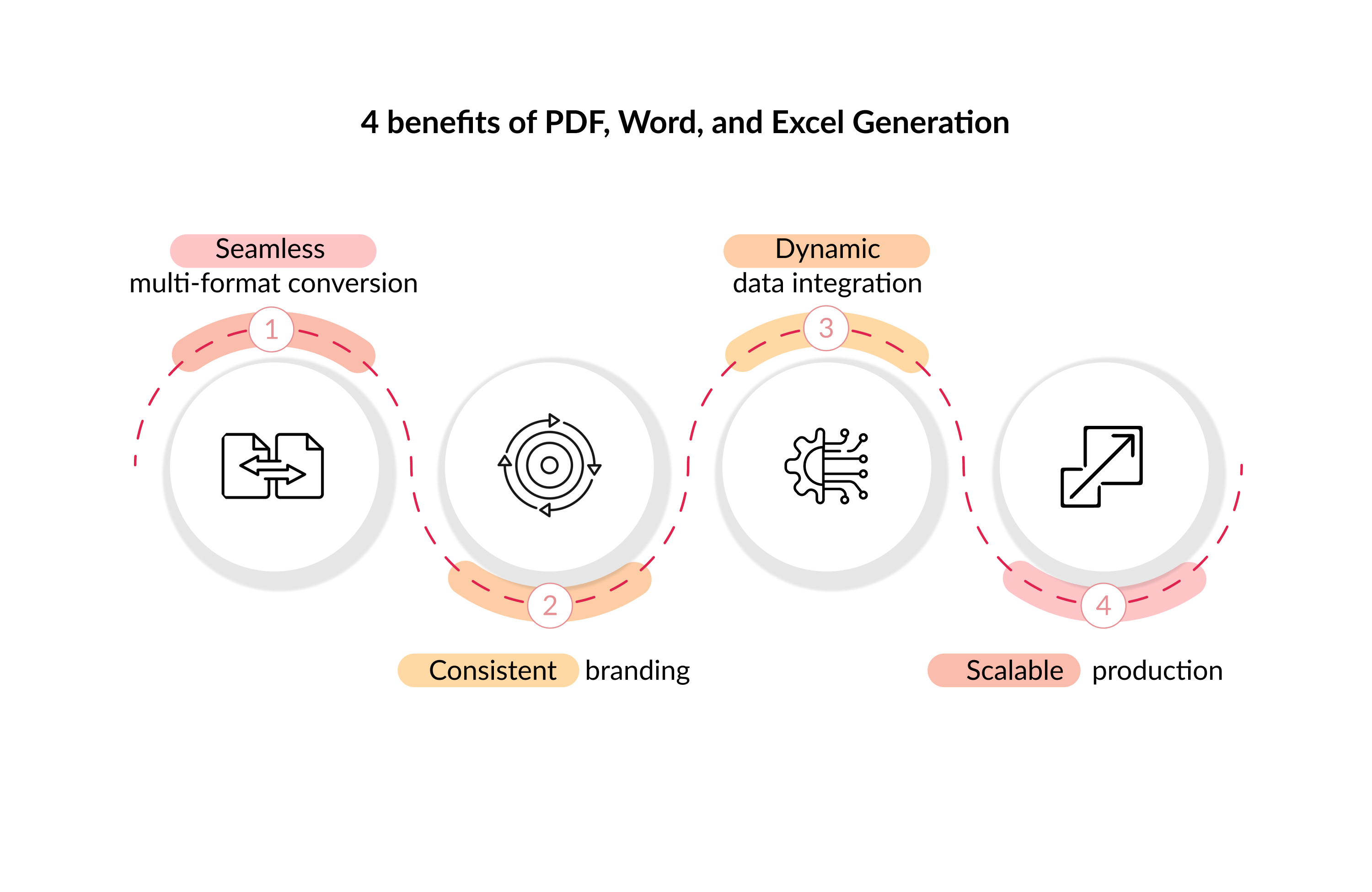
Here are 4 benefits of automating the process:
- Seamless multi-format conversion to easily generate PDFs, Word, and Excel from the same source content.
- Dynamic data integration to pull information from databases, CMS fields, and external sources to populate templates automatically.
- Consistent branding to maintain corporate identity, brand, and style across all reports.
- Scalable production to generate one document or hundreds, all fully automated.
Reduce manual workload, and partner with us!
Multi-Level Template Generation Approach
Intelligent template design is a key component of producing high-quality documents. At Quintagroup, we use a multi-level template system to accept reports of any complexity level, allowing you to automate documents ranging from simple letters to more detailed analytics reports.
1. Basic Word Templates
These are preformatted Word documents with placeholders for text, graphics, and basic tables. They are a perfect match if you need periodic reports or standardized documents with known content structures. Basic templates establish a foundation for consistent appearance while allowing for quick document creation with little configuration.
2. Advanced Templates
Advanced templates include dynamic elements like conditional sections, automatic calculations, and database-driven tables. A financial report, for example, can automatically alter parts based on data thresholds, while a research report can include charts and tables that are adapted to the most recent dataset. This strategy minimizes human editing while keeping documents correct and up to date.
3. CMS-Generated Template Combinations
For highly complex reporting needs, our solution can combine multiple templates into a single cohesive document. This modular approach allows businesses to create multi-section reports with dynamic content, supporting workflows where reports consist of different data sources, multiple authors, and custom layouts.
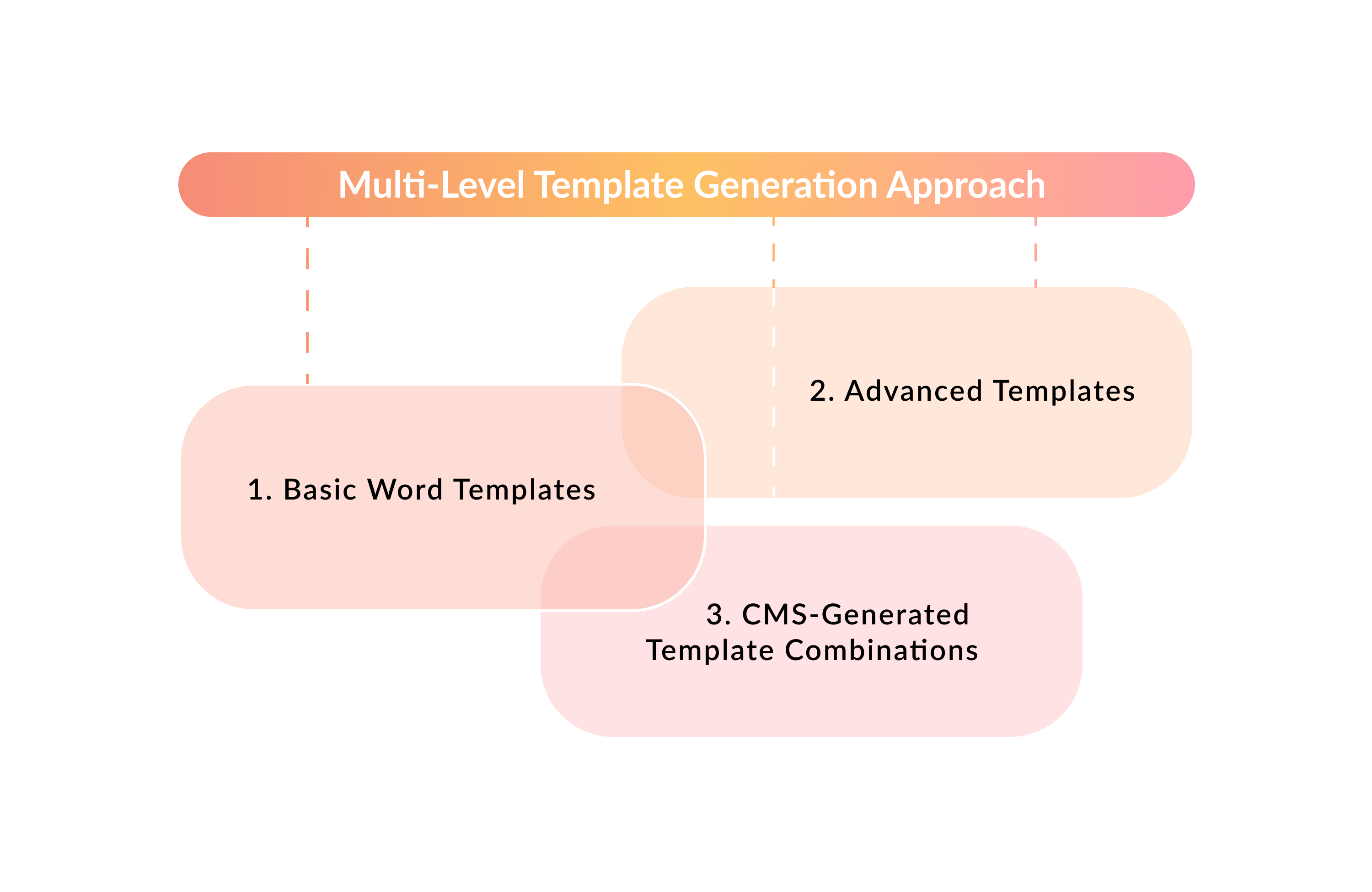
By adopting this hierarchical template strategy, organizations can scale their reporting operations, transitioning from simple recurring documents to fully automated, high-complexity reporting without sacrificing quality or control.
High-Quality PDF Generation Using LibreOffice & Microsoft Word Layout Engine
PDF is still the most widely used format for sharing reports, and its quality is important. To maintain formatting consistency, Quintagroup uses Microsoft Word's layout engine in addition to LibreOffice, a top-notch PDF engine.
This combined strategy ensures:
- Pixel-perfect Word template conversion to PDF
- Precise typography on all platforms
- Tables, charts, and visuals that look consistent
- Documents that are print-ready and appropriate for business settings
LibreOffice has a reliable, strong conversion layer that can handle large, multi-page documents without experiencing any performance problems.
Web Renderer: A Dedicated Document Generation Engine
Our experts decided to go the extra mile for our clients and created the Web Renderer Tool. It lies at the core of our architecture, allowing us to integrate it with various endpoints via API. The Web Renderer is a standalone document generation engine; it has its own API and is not tied exclusively to Wagtail or Django-based systems.
This means:
- It can be used in Django projects
- It can be integrated into other Python frameworks
- It can be connected to JavaScript-based applications
- It can operate independently of CMS platforms
The Web Renderer will give you the benefit of having a universal document assembly engine that receives structured data and templates, merges them intelligently, and returns a fully generated .docx file.
The Complete Workflow: From Database to Final Document
To help you understand the sophistication of our approach, let’s look behind the scenes at the exact workflow. This transparency highlights both our technical expertise and the reliability of our process.
Step-by-Step Document Generation Process:
1. Extract data from the database
Structured data, including analytics, statistics, text blocks, and metadata, is provided by CMS and related systems.
2. Serialize data to JSON
We transform the extracted data into JSON, which the web renderer can comprehend, before sending it to the rendering service.
3. Attach the selected Word template
Each template uploaded to CMS has a unique code. Once selected, it is paired with the serialized data.
4. Send the template & data to the Web Renderer
The Web Renderer intelligently traverses the template structure, identifies insertion points, injects structured data, and assembles the final document automatically.
5. Render the document
The renderer inserts every piece of data into the correct location in the .docx template, generates images or tables if needed, and constructs the final document.
6. Receive the generated file
The renderer returns a finalized .docx file.
7. Store the generated file in the appropriate CMS folder
The user can download it instantly or use it in further workflows.
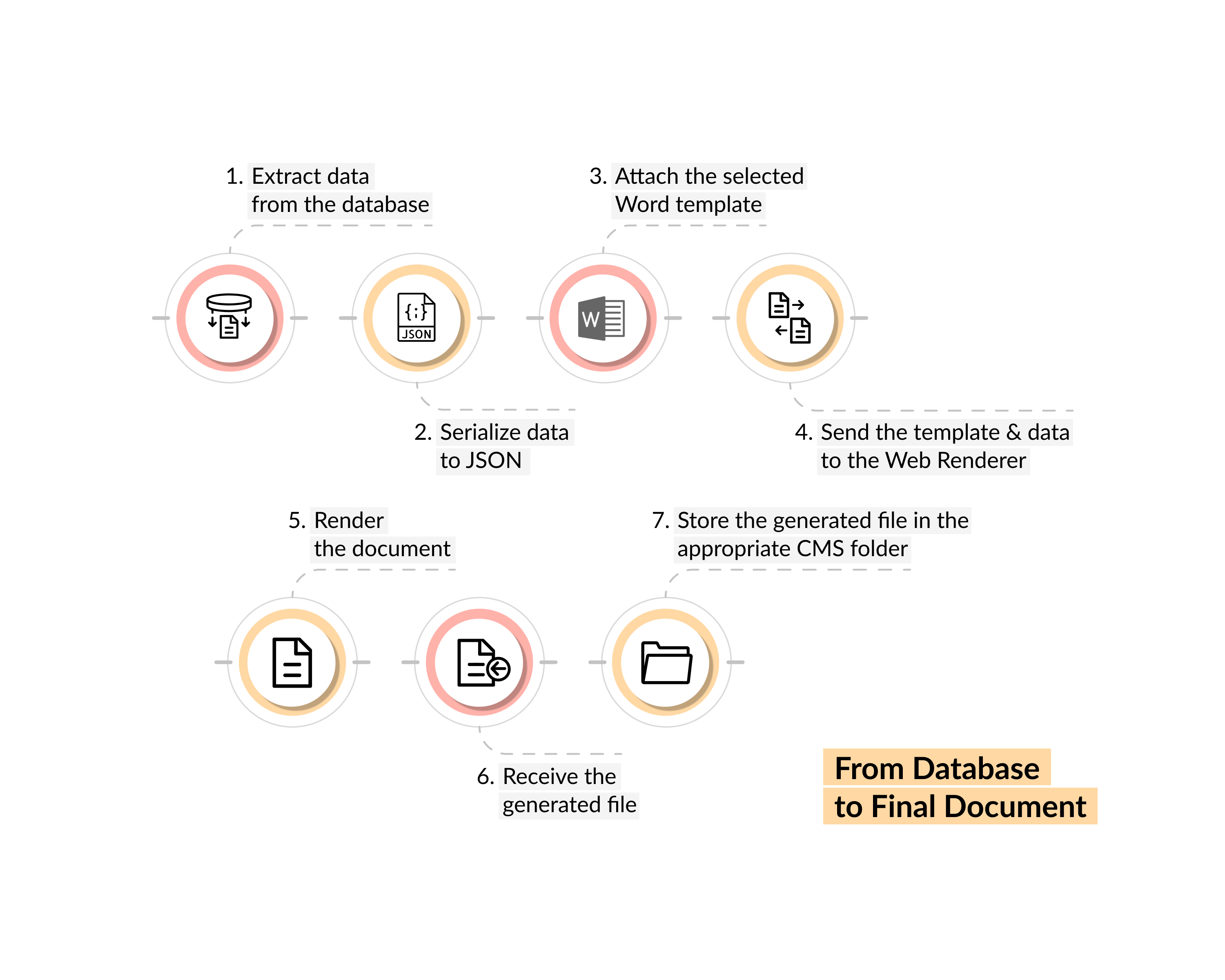
This entire process takes place within seconds! Seconds, and you’ve got high-volume, repeatable document generation with minimal human involvement.
Tech Stack We Use
Our solution is built using a reliable and scalable open-source tech stack:
- CMS for managing templates, structured content, and workflow logic
- Python & Flask to power the web rendering service
- python-docx for dynamic Word document generation
- openpyxl for creating Excel exports
- LibreOffice for high-quality PDF generation
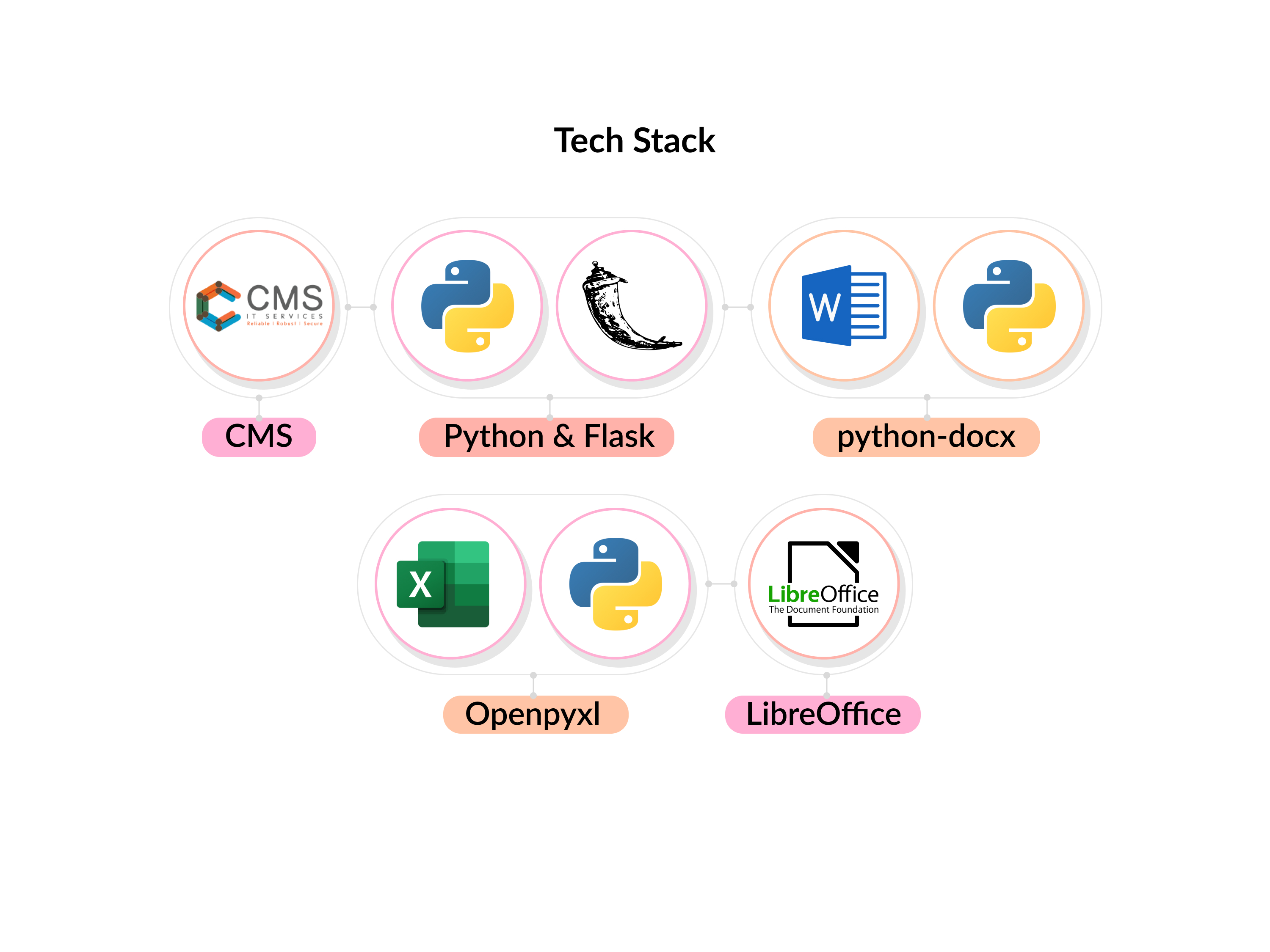
This stack guarantees resilience, adaptability, and extension, whatever the complexity of your case is.
Quintagroup Is Your Ideal Partner
Quintagroup combines excellent Python technical abilities, an in-depth understanding of CMS, and specific competence in document automation. Our approaches are unique because they are:
- Highly customizable and adapted to your templates, data structures, and workflows
- Technically advanced, using dynamic rendering engines and multi-level templates
- Enterprise-ready, scalable, reliable, and secure
- Focused on real business needs because they are built to reduce manual work and speed up reporting
We help businesses in rethinking and automating their whole reporting ecosystem, not simply creating paperwork.
Unlock Automated Reporting for Your Organization Today!
If your company produces a lot of complicated or data-heavy documents, Quintagroup can significantly reduce your time and effort while enhancing document accuracy and consistency.
Reach out to us to explore how automated PDF, Word, and Excel generation from CMS can transform your reporting pipeline.